

A Horizon of Broken Stones

A Horizon of Broken Stones
Some years ago, I spent two weeks at an Ayurvedic resort in the mountains near Pune, in Western India. The resort overlooked a deep sapphire lake, set in a bowl of scrubby hills the colour of fallow deer. The nearest town was a couple of hours drive away, along a single, bumpy, winding road.
After a fortnight of exquisite, healing silence — no ringing phones, no tv or radio; just the chirping of crickets at night; the chatter and laughter of the staff near the central building that housed the kitchen and offices — my friend and I went for a walk down the dusty road to a makeshift encampment below, where a ragged road-crew was hard at work rebuilding a portion of the road that had washed away the previous monsoon.
Several families lived by the side of the road in little shanties cobbled together out of sticks and branches; bits of frayed, sun-bleached sackcloth; sheets of tin hammered out from old oil drums, their colored logos scratched and dented but still faintly visible.
The men did the heavy work — hauling boulders onto the work site in handcarts, loading and unloading the idling truck that spewed fumes into the mountain air, manning the machine that spread hot tar onto the prepared roadbed.
The women carried rocks in shallow metal basins balanced on their heads. Some cooked over open fires, yelled at toddlers to get out of the way of heavy machinery, wiped the runny noses of babies slung across their hips.
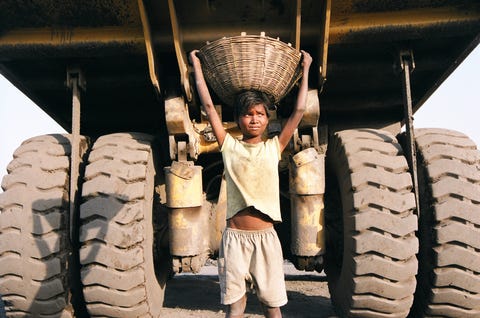
And then, there were the children, bent over like little elves, their stubby fingers clutching stones which they used to smash rocks into smaller pieces. These would be loaded onto the idling lorry which would haul them down the road to where the men laboured, spreading crushed rock onto red laterite mud to make a new roadbed.
These kids ranged in age from two or three to eight or ten — it’s hard to tell how old they were because malnutrition keeps them small and and the relentless sun under which they worked all day had wizened their skin to leather.
We stopped to chat with them. My friend, who lives in Pune and speaks fluent Marathi, translated. The kids gathered around us, chattering excitedly as they bit into the snacks and sweets we’d brought them from the tiny roadside shack a couple of miles away.
We asked them the usual questions. They answered, as kids do — vague about the things that matter more to grownups than to children; clear and forthright about what’s vivid to them.
No, they did not go to school. Their parents moved around the country, going wherever the work was, so they never stayed in one place long enough to go to school. Besides, one of them said proudly, they were needed. Their families depended on their labor, for food and shelter from the rain.
What did they want to be when they grew up, we asked.
There was a moment’s pensive silence. Then, a chorus of high-pitched voices: “To be a stone-breaker!” “I want to be the fastest, bestest stone-breaker”, said one green-eyed beauty, shyly.
“Stone-breaker! Stone-breaker!” they called, excited to be asked; delighted to have a calling of their own.
Then a young man in ragged yellow shorts — all of six years old; clearly the leader of the pack — yelled: “I’m not going to be a stone breaker! I’m going to be the man who drives the lorry that carries the broken stones!”
His voice was triumphant, his dusty face glowed. The children fell silent and looked at him with something like wonder.
Stones.
This young man’s vision for his life was more expansive than anything these children — or anyone in their families — had ever dreamed of.
It emerged from the Land of Broken Stones. Its horizon was circumscribed by stones: breaking them; transporting them; building roads with them. That was their world. That was who they believed themselves to be.
We left them with sticky hugs and bottles of cold, orange Fanta. Tears (mine). Happy waves and calls of “Bye-bye!”
The next day, I was to take a train back to Bombay, then a flight home to Canada. My friend promised to connect with an NGO in Pune, who she said would send someone out to get these kids into the village school; would bring along a mobile medic to check and treat them for ringworm and rickets.
That night, I lay awake, my heart troubled by questions as insistent as the moonlight that streamed across the the lake’s inky depths.
What happens to an ecosystem like that of these families, with their nomadic existence, their traditional ways of living and working, being in community, relating, when outsiders such as my friend and I intervene with our notions of how they could or should live? What might happen if that fearless young man with his dream of driving a lorry did in fact discover horizons far beyond the Land of Broken Stones? What, in the adamant strata of caste- and class-ridden Indian society would support his dreams consistently enough so he could shape a new reality for his life?
I ask the Deva of India: What can I offer that would enhance these children’s lives without causing harm? That would be sustainable and renewable over their lifetime?
The Deva directs my attention to what is mine to tend right now.
You’ve travelled far beyond your own Horizon of Broken Stones. You’ve paid a price for departure, another for arrival. Each departure is a rupture, and the fault lines of rupture are seams across the landscape of your life. They are also pathways between where you’ve been and where you’re going.
Each arrival calls you to embrace an unknown that remains essentially unknowable, with a heartbeat as familiar as your own.
Life calls you back from the horizon of your imagination. It calls you to a humbler response.
Your life is with your community, your children and beloveds, the work of your soul and the gifts of your hands. Your horizon is ringed by love -- the responsibilities love so gladly assumes.
These horizons invite you into love’s ongoing incarnation. They reveal themselves with each faithful, faltering footfall.
Go home. Make home.